
Caravan & touring
How to Test Your Caravan Battery Safely
A flat caravan battery can quickly turn a good trip into a frustrating one. Your lights stop working, the fridge cuts out, the water pump struggles and suddenly you are trying to work out whether the battery, charger or solar system is causing the problem. A basic voltage check is a useful place to start. It only takes a few minutes, but it needs to be done safely and interpreted properly.
7 min read
At a glance
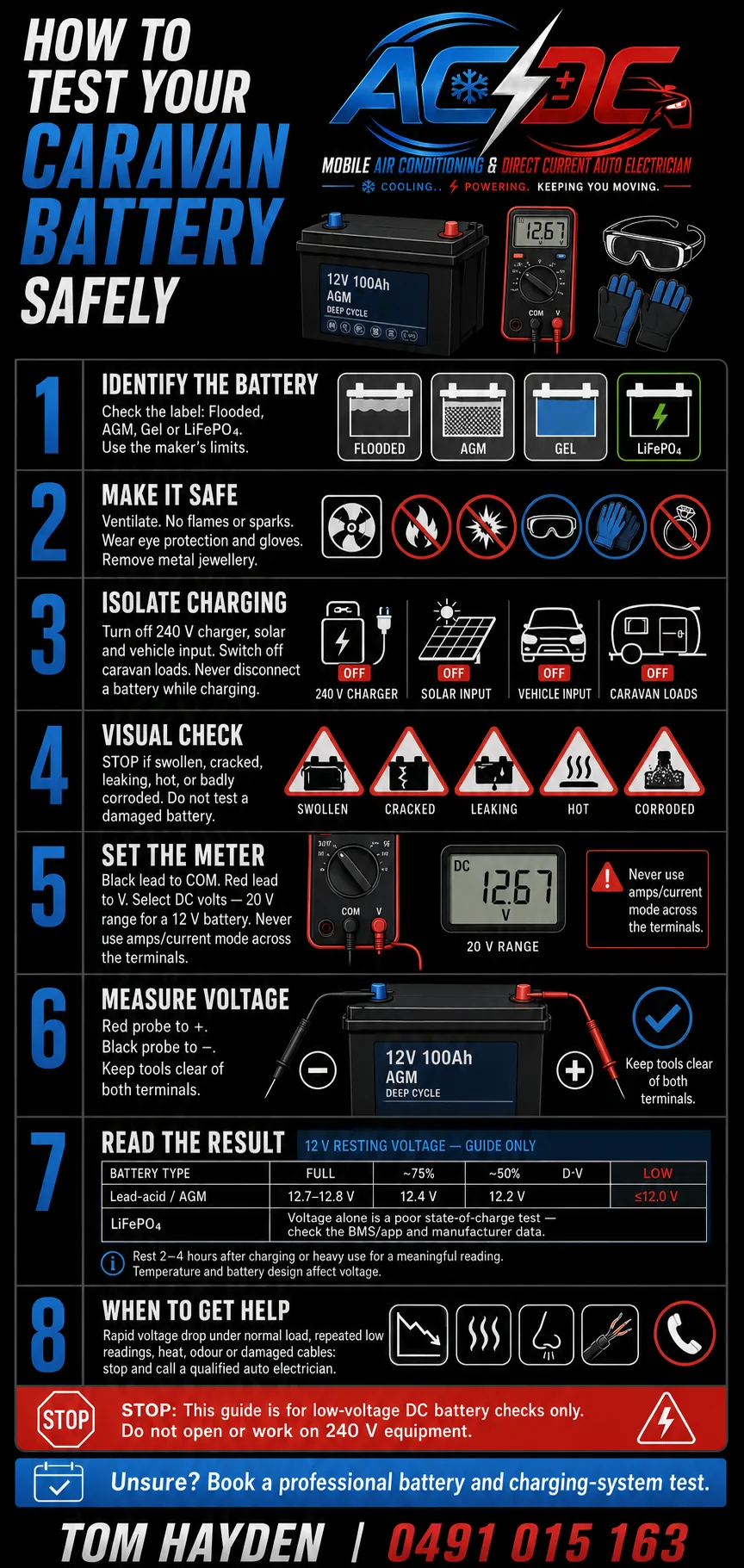
First, know what type of battery you have
Before testing anything, check the label on the battery. Most caravans use one of the following: flooded lead-acid, AGM, gel or LiFePO₄ lithium. This matters because the normal voltage range and testing method vary between battery types. A voltage reading that is useful for an AGM battery may tell you very little about the actual state of charge of a lithium battery.
If you are unsure, follow the battery manufacturer's specifications.
Make the area safe
Caravan batteries can deliver a very high current if they are accidentally short-circuited. A dropped tool or incorrectly connected meter can cause burns, damaged wiring or a fire.
- Work in a well-ventilated area.
- Keep flames, cigarettes and sparks away.
- Wear eye protection and gloves.
- Remove rings, watches and other metal jewellery.
- Keep tools clear of both battery terminals.
Isolate the battery from charging sources
For a meaningful resting-voltage reading, the battery should not be charging or powering caravan equipment. Never disconnect a battery while it is actively charging.
- Turn off or isolate the 240-volt battery charger.
- Switch off solar charging.
- Disconnect the vehicle charging input.
- Turn off caravan lights, pumps, inverters and other loads.
Inspect the battery before testing
Take a good look at the battery, terminals and surrounding cables. Do not test or attempt to recharge a visibly damaged battery. A swollen or hot battery can be unsafe to handle.
- A swollen or distorted battery case.
- Cracks or leaks.
- Excessive heat.
- A strong or unusual smell.
- Heavy terminal corrosion.
- Burnt, damaged or loose cables.
Set up your multimeter correctly
Connect the black meter lead to the socket marked COM. Connect the red lead to the socket marked V for voltage. Set the meter to DC volts. If the meter is not auto-ranging, select the 20-volt range for a 12-volt caravan battery.
This next point is important: never place a multimeter across the battery terminals while the meter is set to amps or current mode. In current mode, the meter creates a very low-resistance path across the battery. This can blow the meter fuse, damage the meter, create a spark or cause injury.
Measure the battery voltage
Place the red probe on the positive terminal, marked +. Place the black probe on the negative terminal, marked −. Hold the probes firmly and make sure they cannot slip or touch each other.
If the display shows a negative number, the probes are reversed. Swap them around and test again. For a useful resting-voltage reading, the battery should ideally sit without charging or heavy use for two to four hours. Testing immediately after charging can give an artificially high result because of surface charge.
Understanding the result
For a rested 12-volt lead-acid or AGM battery, the following figures provide a general guide. These figures are a guide rather than a final diagnosis. Temperature, battery construction, age and recent use can all affect the reading.
A battery can also show an acceptable voltage with no load and then collapse when the fridge, water pump or inverter starts. Open-circuit voltage does not prove that the battery still has good capacity or can supply current properly.
| Resting voltage | Approximate state of charge |
|---|---|
| 12.7–12.8 V | Full |
| 12.4 V | Around 75% |
| 12.2 V | Around 50% |
| 12.0 V or below | Low |
What about lithium batteries?
LiFePO₄ batteries maintain a relatively flat voltage through much of their usable charge range. That makes voltage alone a poor way to estimate their state of charge.
For lithium batteries, check the battery management system, monitor or manufacturer's app where available. Follow the manufacturer's voltage limits and shutdown procedures. If the battery management system has disconnected the battery, do not assume the battery is simply flat. The system may have responded to low voltage, high current, temperature or another fault.
When should you call an auto electrician?
A professional battery and charging-system test is recommended if you notice any of the following:
- The voltage drops rapidly under a normal load.
- The battery repeatedly goes flat.
- The battery will not hold its charge.
- The terminals or cables become hot.
- The charger does not reach the correct voltage.
- There is visible corrosion or cable damage.
- The battery smells unusual, leaks or becomes swollen.
- The solar, vehicle and 240-volt charging systems give different results.
A proper assessment looks at the complete system
The battery is not always the real problem. Poor cable connections, undersized wiring, parasitic loads, charger faults, solar regulator problems and incorrect charging settings can all cause similar symptoms. A proper assessment looks at the complete system — not just the battery voltage.
If you are unsure, stop and have it checked. A professional test can identify whether the problem is the battery, the wiring or the charging system before it leaves you stranded.
Unsure about your caravan battery?
Tom can test the battery, charging system and 12V setup on site, and tell you whether the problem is the battery, the wiring or the charging system before you head off.